- Employer Resources
- |
- Last Updated: May 27, 2026
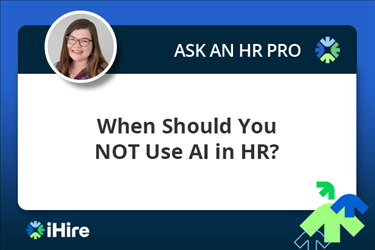
Ask an HR Pro: When Should You NOT Use AI in HR?
The adoption of artificial intelligence is rapidly transforming human resources. From drafting job descriptions to screening candidate resumes, technology is speeding up processes for organizations of all sizes.
But while these tools offer incredible efficiency, they cannot replace the human element of HR.
Relying too heavily on technology for people management can quickly damage employee trust and company culture. So, when should HR professionals step back from the keyboard and handle situations themselves?
Vickie Krolak, SHRM-CP, SPHR, Principal of Outsourced HR Services at iHire, shared her insights on when not to use generative AI for HR and why genuine human connection matters more than ever.
Navigating Sensitive Employee Relations
When it comes to delicate interpersonal matters, like conflicts, coaching needs, performance reviews, promotion considerations, and terminations, AI in HR falls short. Employee relations require empathy, nuance, and emotional intelligence that algorithms simply do not possess.
“When an employee comes to you with a personal crisis or a conflict with a coworker, they need someone who can listen and understand the emotional weight of the situation,” Krolak said. “Using AI for HR tasks like conflict resolution, harassment investigations, or delivering difficult news can come across as cold and robotic. And frankly, they’ll be able to tell.”
Employees want to feel heard and validated by a real person. Relying on AI-generated responses in these moments can escalate tensions and damage the psychological safety of your workplace.
Complex Legal and Ethical Interpretations
Employment laws are constantly shifting. What is compliant today might change tomorrow. Furthermore, every organization has unique ethical standards and cultural nuances.
“If you rely entirely on technology to interpret complex legal issues or ethical gray areas, you open your organization up to significant risk,” advised Krolak. “AI is trained on historical data, which means it can inadvertently reproduce existing biases. This can lead to unfair outcomes in performance evaluations or disciplinary actions.”
Navigating these complex waters requires human judgment. You must understand the context of a situation and apply your company values accurately. Figuring out how to use AI in HR effectively means recognizing when a situation requires a human legal review.
Driving Strategic Vision and Innovation
Technology is fantastic at analyzing large data sets, but it struggles to build a long-term strategic vision. Fostering a healthy workplace culture and driving true innovation requires human creativity.
“AI can give you turnover statistics, but it cannot sit in a room with your leadership team and brainstorm creative ways to boost morale,” Krolak noted. “Developing long-term HR strategy requires understanding the unique personalities, strengths, and goals of your workforce. It takes a human to build mentoring programs, design meaningful career paths, and inspire a team to reach new heights.”
The Rise of Religious Accommodations Against AI
Interestingly, a new challenge is emerging for employers navigating AI in HR: employees seeking accommodations based on religious beliefs regarding AI usage in their daily roles.
Some workers feel that using certain artificial intelligence tools conflicts with their personal or religious principles. They might object to how generative AI for HR models are trained, or they may have fundamental beliefs about the intersection of technology and human agency.
“You have to treat these accommodation requests with the same sensitivity and compliance standards as any other religious accommodation,” Krolak explained. “It requires an interactive dialogue with the employee to find a reasonable solution that respects their beliefs without causing undue hardship to the business.”
Finding the Right Balance
Despite these limitations, there are many appropriate ways to leverage AI for HR. Automating repetitive administrative tasks, running data analysis, and conducting initial resume screenings are all great examples of how technology can help your team.
But, human oversight is mandatory. You should always review AI-generated content before sending it to employees or candidates.
“When we talk about how to implement AI in HR responsibly, we are really talking about balance,” said Krolak. “Use the tools to gather data and draft initial ideas, but always apply your own creativity, critical thinking, and expertise before making a final decision. You can’t rely on AI to solve complex questions.”
Maintaining the Human Touch in HR
The evolving skill set for HR professionals now involves knowing exactly how to use AI in HR to save time, freeing you up for strategic and empathetic work. It’s a continuous learning process that requires careful thought and strategic planning.
And to build a thriving workplace, you must know when to close the laptop and simply talk to your people.
“Treating employees well will always be a core component of retention and business success. While AI offers exciting opportunities to streamline workflows, it will never replace the empathy, judgment, and creativity of you – the dedicated HR professional,” Krolak continued. “The key is to learn to work alongside the technology. AI should be an extension of our human capacity and not limit our possibility to solve problems. We don’t want to lose our human ability to be creative.”
Explore our Resource Center for more expert tips from Krolak and our HR pros. You can also schedule a free consultation with our team for guidance on implementing AI in your workplace or any other HR topic keeping you up at night.
RELATED RESOURCES

Hiring? You're in the Right Place.
- Reach unique talent: 51% of our candidates aren't using other job boards
- Connect your ATS and get 6x more applications with iHire's apply process
- Get matching candidate resumes sent straight to your inbox
We Value Your Privacy